The Last House on the Line
For a century, grid engineers designed the whole feeder around one customer: the last one. Rooftop solar broke that rule — and took the industry's easiest fairness answer down with it.
Grid Signal — Issue #010 · August 2026
Two neighbours, one sunny Saturday
Two houses on the same street, same feeder, same cloudless afternoon. Both have rooftop solar. By one o'clock, one inverter has quietly throttled itself back. The neighbour exports at full power. Same weather, same tariff, same grid.
Ask anyone with grid intuition who gets curtailed first and you'll get a confident answer: the house at the end of the line. Farthest from the substation, weakest voltage, first to feel any squeeze. The intuition has real roots — for a century, the end of the line was the point the whole feeder was engineered around.
The last house was the design case
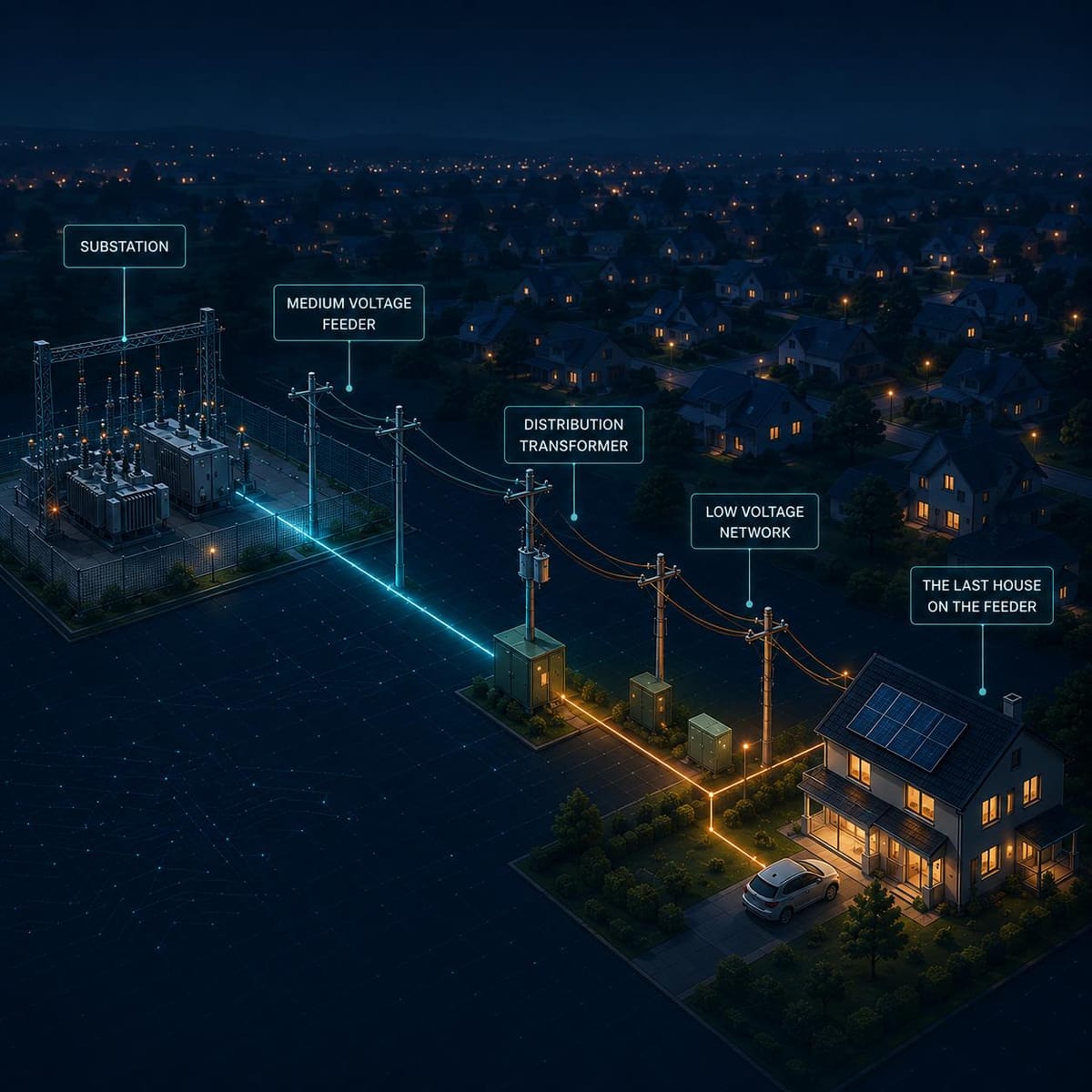
Classic distribution engineering treats a feeder like a garden hose: pressure highest at the tap, lowest at the far end. At evening peak the last customer sees the worst voltage, so engineers made that customer the design case: conductors sized, transformer taps set, voltage bands allocated so the far end still holds up at full load.
Be precise about what that era did and didn't have. Household solar wasn't being curtailed through some fairness queue — there was nothing to queue. Where the grid did reach into homes, it reached in bluntly and by class: ripple control switched storage heaters and tariff groups in whole cohorts, everyone on the same signal at once. Interventions were coarse, collective, and above all legible. Worst-served customer? Point at the map.
Position was destiny, and destiny was legible.
Then the power turned around
Rooftop solar reversed the flow. On a bright midday with light load, a PV-heavy feeder pushes power backwards, toward the substation — and voltage no longer sags along the line. It rises. Overvoltage, not undervoltage, becomes the binding constraint, and it peaks wherever generation clusters relative to load, not at a fixed distance. A solar-dense pocket halfway down the feeder can sit at a higher voltage than the literal last pole. By evening, EV chargers and heat pumps flip the profile back the other way.
Position still matters — impedance is impedance. But it stopped being the ranking. Your voltage now depends on your neighbours' panels, batteries and charging habits as much as your own address — down to which of three phases your service drop lands on.
Nobody is holding a list
Here is what actually breaks the intuition: nobody decides the order anymore.
There is no control room working its way down a ranked list of households. Europe's connection rules — VDE-AR-N 4105 in Germany, EN 50549 across the EU, IEEE 1547 in the US — put a first response into the device itself: an inverter watches the voltage at its own terminals and, when it climbs too far, dials its own output back. Which functions are switched on and how they're tuned varies by country and operator; the direction doesn't. Our Saturday house wasn't picked by anyone — its inverter saw high voltage, followed its curve, throttled. The neighbour's inverter saw normal voltage and did nothing. The operator still holds bigger, remote switches for real congestion — but those too fire on network state, not street address.
The rulebook is the same for everyone — equal treatment, on paper. But the grid doesn't serve everyone the same voltage: houses at electrically weak points hit the threshold first and curtail hardest, while identical hardware two streets over exports all summer, untouched. Engineers now have a name for this — "fair active power curtailment" — a growing research field repairing a rule that was never unfair on paper. Only in outcome.
Germany wrote the same shift into law for the consumption side. Since January 2024, every new wallbox, heat pump or home battery above 4.2 kW must be controllable — §14a EnWG. The grid operator may dim it, but only against a concrete local overload, and only down to a guaranteed minimum — 4.2 kW in the standard case, never to zero — while the household pays reduced network charges in return. The trigger is whatever the network is doing right now — not a queue, not a rotation, not a position on a map: a live local judgment, executed in software.
Curtailment used to be a question you could answer with a map. Now it's an outcome.
What the cloud architecture perspective adds
I'm not a grid engineer and I don't pretend to be. But this migration is structurally familiar. The classic grid ran like a single load balancer in front of a small, static pool — few actuators, central logic, auditable by inspection, boring in the best way. The modern feeder runs like a fleet: every instance executes its own autoscaling policy off its own local metrics, while an operator can still push setpoints over the top when things get tight. Behaviour emerges from thousands of local control loops plus the occasional remote override — a hybrid, not a hierarchy.
Cloud teams learned the hard lesson of that architecture years ago: the day something goes wrong, "which node did what, and why" is unanswerable — unless every node logged what it saw at the moment it acted. So the logging became non-negotiable. A scaling event carries the metric that triggered it, the threshold it crossed, the policy version that fired. When a customer asks why their instance was terminated at 14:02, the answer is a lookup, not an investigation.
The household asking "why me?" is that customer. And here is the twist: on today's feeder, the logs mostly exist — inverter logs, dimming commands, meter records. They just live in different systems, on different clocks, under different owners. Not missing. Scattered. Which, for the person asking, amounts to the same thing.
"Why me?" needs an evidence trail
Issue #009 argued that every dispatch decision should be a signed, tamper-evident record — the grid's version of that lookup. A record proves what happened; it cannot, by itself, prove it was fair. And what decided, this afternoon, which of two neighbours got dimmed was a stack: local physics, device firmware, a DSO congestion signal, an aggregator's optimiser.
Be honest about who asks. Households mostly don't — a few percent of PV yield lost to a volt-watt curve is invisible. It changes when curtailment is felt and has money attached: a dimmed wallbox is a car that isn't charged in the morning, and §14a devices pay reduced network charges for being controllable. Once you're paid to be dimmable, "am I dimmed more than my neighbour" stops being philosophical.
The business case doesn't wait for angry households anyway. Three parties need this record for their own reasons. Settlement: when the grid instructs a generator to curtail today, compensation is calculated from the energy it would have produced — an invoice built on a counterfactual someone has to reconstruct and defend. §14a pays differently, reduced network charges rather than per-event compensation — but the direction of travel is per-device flexibility with money attached, and you cannot settle what you cannot reproduce. Regulatory cover: a DSO may dim only against real local congestion and must be able to show, afterwards, that each intervention answered one — its customers are captive, so the regulator, not churn, is the pressure that counts. Asset acquisition: aggregators compete for other people's batteries, and "we never cycled yours beyond contract" is a cheaper pitch than "trust us" — but proving it takes the rule, the state it read and the outcome, per device, across the asset's life. Nobody buys transparency. They buy settlement, regulatory cover and asset acquisition — transparency is the exhaust.
So the record from #009 needs to carry three more things. The rule that acted — the volt-watt curve, the dimming logic, the allocation policy — versioned, so every event references the exact logic that produced it. The local state that logic consumed: terminal voltage, congestion signal, state of charge. And enough of both, signed, that a dispute doesn't start from zero — replayed where inputs and model allow it, a complete evidence package where they don't. The uncomfortable part isn't the cryptography. It's governance: who owns that registry, who may publish a new rule version, who vouches for a device's identity across a fifteen-year life. Signing is a solved problem. Deciding who signs is not.
That question is where this arc goes next: Issue #011 asks what human oversight honestly means when the control loop is a firmware curve reacting in milliseconds; #012 follows the trust chain to its final metre — a heat pump with no signing key and no way to get one.
For a century, the map on the wall told you who would feel the grid's limits. That answer now lives in firmware curves, congestion signals and optimiser state — scattered across systems that share neither a clock, nor an owner, nor a format. Nobody holds the answer to "why me?" anymore. It has to be built. Build the record.
Sources
- VDE-AR-N 4105 (Germany) and EN 50549 (EU) — low-voltage connection rules with autonomous voltage-response functions; IEEE 1547-2018 as the US counterpart — NREL, "Highlights of IEEE Standard 1547-2018"
- § 14a EnWG, controllable consumption devices (mandatory for new devices > 4.2 kW since 1 January 2024) — gesetze-im-internet.de
- Position-dependent curtailment under identical volt-watt settings — "Optimal PV active power curtailment in a PV-penetrated distribution network using optimal smart inverter Volt-Watt control settings" (2024) · "An Enhanced Voltage Control Method for Fair Active Power Curtailment of Rooftop PV Systems in LV Distribution Networks" (2024)
Grid Signal is written from the perspective of a cloud solutions architect working with the energy industry. It reflects engineering interpretations of public regulations rather than legal advice. Opinions are my own.
Comments ()